Showing posts with label shakespeare. Show all posts

Wednesday, April 26, 2017

Oh My: Part Three

And its original title:

Disco-y Spiders, Orphans, and Flirting with my Best Friend's Love/Twin

January 2013. Tempest auditions.

I manage to forget my set piece.

Just to clarify, this endangers my entire construction of self-concept, and even now I will bitterly insist that it had everything to do with circumstance and nothing to do with disposition or ability... even though there were absolutely no justifying circumstances. But I digress.
See, it was Prospero's soliloquy from Act Five of The Tempest, and I fancy myself a Shakespere nerd, so this cognitive dissonance was too much for me to handle.

For years this has haunted me. Often, late at night, I'll wake up drenched in a cold sweat, and it begins... 'I have bedimmed the noontide sun'... I writhe in my bed sheets, begging for the playwright's forgiveness, yet still I can FEEL the spirit of Shakespeare shooting me disapproving glowers from the shadow-shrouded corner. In a very (characteristically) plaintive fashion, I siphoned the shame from this moment to torment myself endlessly.


"Of course-- this is why I couldn't be in Les Miserables, or anything. I have no talent for drama whatsoever," I moaned, swooning to a pale faint on the floor, my champagne spilling in an arc around me, eyelids fluttering shut to the cameras.


All this in my head, of course.
Because I was in the play. And, I had lines.*

I was cast as Adrian. To emphasize, the male character of Adrian. To really drive this home for all y'all folks who don't know me personally, I am about as stereotypically feminine as a kitten in a basket of flowers wearing a lacy bonnet. Having tea with all the Disney princesses, simultaneously.
Obviously, some coaching was needed. My peers attempted to aid me backstage, which was largely unsuccessful, not to mention frustrating for everyone involved.

In time, though, I became the very portrait of masculinity.

We got in trouble a lot during rehearsals. And by this I mean, I got in trouble, and by chance at times dragged other people down into the flaming pits of Tartarus with me.
One time, I jumped out of a broom closet at my friend. Screeching violently. In my head, it was a very tactful fling from the top shelf into a graceful somersault, but I think I actually knocked my skull on the ground and everything beyond that point has been the product of my comatose imagination. Coolio.
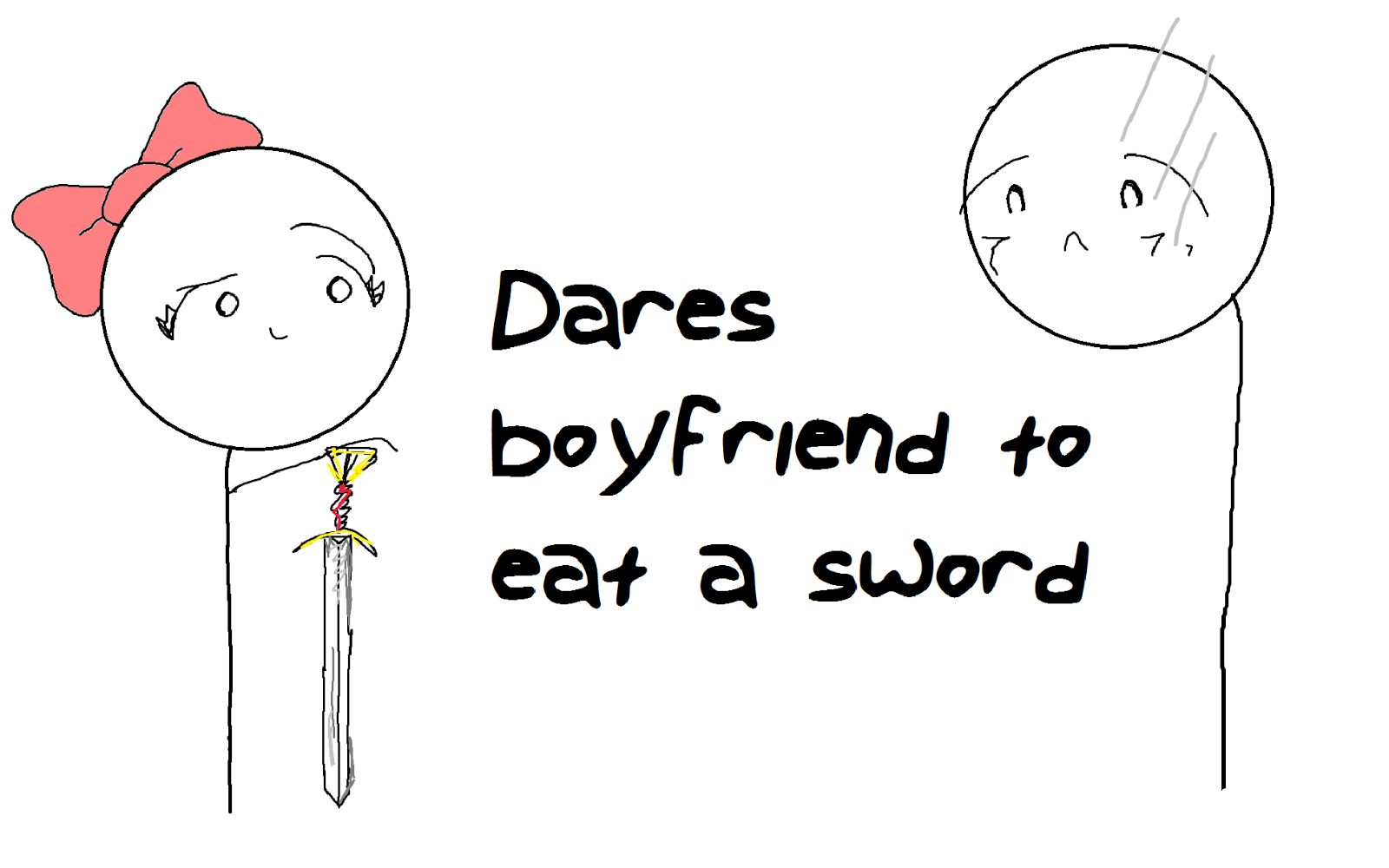
Another time:

Also, I had a monstrous crush on the guy playing Caliban (*snrk*, pun). Like my mom says, I have propensity to fancy guys who look like plague victims.


I am in a perpetual state of infatuation with Shakespeare. And therefore, his masterpiece, Caliban. (heh, sorry real-life boyfriend....)
Such a pity we couldn't've had more scenes together. When you're the naïve king's lord whose main role is faux perspicacious comments and he's a poetic villain bent on smashing the protagonist's head in, the fault is, in fact, in your stars. 

I was crushed when our productions of The Tempest were over. It left in its place a perpetual longing, as does every passing play.

Flash forward another year. More Shakespeare. 
This time, I was determined to not be an idiot/to have my set piece truly committed to memory and flawlessly performed. It was Much Ado About Nothing, one of my very favorite scripts of all time, and I will admit in the interest of candor that I pined to be Beatrice. She's the silver-tongued, irreverently independent heroine, a fiercely emotional role, and one that I felt I could ease into without any real change of character. Picture me now as a gelatinous goo easily formed to the shape of Beatrice. Okay? Okay.
Some featured commonalities:


I am very glad now, though, that our director cast me into a role that was to all entirely unexpected: a gender-swapped version of Don John, the "Lady Jane". I could fence, I could violently monologue, and I could storm my way offstage over five times. What's not to love?
Okay, in my interpretation, there's only one slight hurdle associated with the switch from lord to lady-- and that's that the character seems to change from:

To:

I believe Borachio rejecting the female Jane added some dimension to both of their characters, as well as an internal redundancy that more accurately portrays the relationships between roles within the play: John/Jane's heinous nature derives from feelings of exclusion and invalidity, which he/she resentfully embraces as authentic to his/her own nature rather than as unjust social perceptions. Of course she'd be rejected. Her expressions in that moment allow for a flicker of empathy. In one of Shakespeare's most passively delegating, obviously malignant villains, it's difficult to interpret the text in such a way that he (or she, in our version) may be understoood. People don't enjoy an antagonist without a meaningful motive.
Shakespeare would be chill with that, I think. Heck, he made so many "Yo Mama" jokes, it's hard to imagine him getting ruffled over any creative liberties one may take of him. Go ahead, stretch that as far as you like.


And so on and so forth until he rolls so much in his grave that the axis of the planet tilts a fraction of a degree further.
Right, I was actually talking about something until I got distracted by the fact that West Side Story is the only non-acceptable Shakespeare adaptation. I believe my next point was that Kelton played Borachio, and it's always awkward to seductively grab your best friend's twin by the shirt collar (speaking from personal experience). I would imagine, though, that it was even worse for poor, dear Katylin.


Talk about a tricky cast to navigate! Through some very tactfully choreographed shadow-play behind a curtain, we were able to manipulate the scene so that Borachio could-- chastely-- woo his Margaret, and thus the heroine Hero could be undone, devastated, and outcast from society in disgrace and ruin, etc etc. (it's a long story). 
(not too long.)


And there you have it. Mix in a little of Benedick and Beatrice insulting each other until they catch feelings, and that's the whole plot. 
Speaking of... I'd like to do a shout-out to our Benedick, Isaac (pronounced i-say-ACK). This guy. Throughout tech week, everyone started to fall ill. Many people lost their voices or became violently nauseous. I threw up and fell asleep on the floor. Isaac, lying there, looked so sunken and pale that we all contemplated appropriate dirges. But... this guy. He pulled it together, almost impossibly, and waltzed up on stage to deliver a striking, dynamic performance-- again and again. Isaac, you were an inspiration to us all. Without you-- and the provisions of "medicinal" ginger ale and french bread helpfully supplied backstage-- we might've given up. I'm at least half certain you rose from the dead that day.

I did so love that french bread, though. Sorry again, real-life boyfriend; I was sick and sloppily emotional and may've gotten "married" to a loaf of bread backstage.


We had it annulled, of course (thanks Henry VIII).

And there, dear readers, I must conclude our tale for today. Primarily because I am lazy. Join me-- after finals week-- for the time I dislocated my shoulder and that other time when I was utterly tone deaf! Until then, have a happy week of doom!!


Monday, January 4, 2016

New Year's Resolution

Working myself into shape was not my New Year's resolution this year. In fact, my resolution last year shifted mid-January from "go to the gym at least 4 times a week" into "never make a New Year's resolution ever again". This is for one simple reason: New Year kinda sucks for introverts, in a lot of ways. A pinnacle among them being the rush that occurs directly succeeding December 31st. If you haven't made a resolution for the year but plan to go to the gym during the month of January for any reason, just don't. Walk in circles around your living room if you have to, or go kayaking downhill in the snow, but avoid the gym for a quarter mile radius.

It's a cultural phenomenon that I like to narrate a la National Geographic. It's the prime season for the developing plumage of these lanky mammals, and they flock to the local calisthenics hole for a much needed "leg day". Ah, look, there's one female of the species now. She's roosted upon what looks to be an artifact of Medieval torture. If you listen closely, you can hear her dying inside...

But that usually gets me in trouble.

Okay, look, disregard that; the problem with these resolutions is that everyone tries to pick the same thing. My big issue with this whole New Year thing isn't in the essence of me celebrating with my cat and a party popper at 9pm ("It's 12 o'clock somewhere"), which, by the way, I actually didn't do this year so the joke's on you, Mom. No, this issue begins the following morning. And it has 99% to do with this glorious blessing that is introversion:


Gym resolutions would be so fun if I was the only one who made them! All of you, stop it. It's my thing now. Give up and go home.

Just once I'd like to ask someone what their goal for this year is to hear them say, "Oh, you know, a bowl of ice cream every other morning, the usual" or maybe "Gee, I hadn't really thought about it-- I think I might like to ride an ostrich this year." People could stand to be a whole lot more accepting of the things they genuinely enjoy, and that'd do it. Here's the thing: the shift to New Year isn't going to change you. You could make the choice to eat better, go to the gym, or get more sleep any other day. It's far better to start the year in a way you'll be glad to end it: Loving yourself.

If painting makes you happy, sign up for the class. Maybe you could challenge yourself to random acts of kindness. You could buy yourself some new mechanical pencils and fuzzy socks, or check Facebook less often, or go walk dogs at the local shelter-- while getting in shape may be a great objective, there are so many other experiences worth living. If your goal is to lose 15 pounds, add in a little bonus of "Visit that fresh market I love, once a week." If you love the concept of your goals but hate how you get to them, you'll run out of willpower along with your happiness. You have to love the journey or you'll turn back on the destination. (I know this because my dad always threatens to "turn this car around right now")

And what do I love to do? Well... read. So I custom-built a 52-week challenge, and it's just descriptive but also vague enough for you to do it with me, if you'd like! Then we can all talk about the books we read in one glorious online nerd haven. Basically, here are the specs: One book per week throughout the year. You can cram all you want, or you can read one each week, but you have to read all 52. In addition, while 13 are free-reads, a whopping 39 have prompts. You can take them in any order you like and push in your free book slots whenever you like. You can also, of course, read books outside of the challenge, or customize it for your own use. Or, you can apply multiple prompts to one book you read. (Though if you do that, you're kind of a party pooper, okay?) A lot of these prompts hail from this year's Popsugar reading challenge. I can't let myself completely decide the prompts, because the whole list would sound a bit like, "nonfiction about physics, nonfiction about birds, nonfiction about Vietnamese cooking..." But I digress. Here it is:


As I read along, I'll be updating my list of books read in the following. It'll offer recommended books for specific prompts, mini reviews, links to larger posts, and general asides:
  • New York Times Bestseller: Life After Life (by Kate Atkinson). A while back I tried to read this book but only had the stamina to get halfway through-- it's not a good first book after a dry spell, I'll note that. It is, however, the most brilliant anti-war novel ever crafted. I hear y'all in the back screaming Slaughterhouse-Five, but I must politely disagree. I've read both, and here is the difference: Slaughterhouse-Five, while a masterpiece all on its own, merely convinces that war is brutal and irrational. Life After Life hits with force, spiraling through a tapestry of the destiny of one woman, Ursula, amor fati, into the pained realization that we cannot know every story. Friends become strangers. Family becomes the enemy. Time after time, new pathways are revealed, new insights, people who we think will live forever and then live short. Life After Life is unique because it looks to the sky. The whole world as a snake with a tail in its mouth. And it dies, comforted, in the hands of a stranger.
  • Finish in a Day: The Crucible (by Arthur Miller). This is one of the three books I brought with me to this year's Winter Camp for my church-- and, due to a surprising amount of sociability, it was the only one I finished. To give warning, it is capable of messing you up psychologically and bringing you awash to your knees in emotion in a mere 143 pages. The very nature of humanity, in all its perilous vengeance, is examined under the light (or, shall we say, darkness) of the Salem witch trials. The deleted act is best read as an epilogue to a very cataclysmic preceding scene; and through it, in the entirety of these acts, you will begin to question what malignant nature resides inside of you, yourself, no matter how pious. The just are not safe, and the wicked are martyrs. Good show, Arthur Miller, good show. 10/10.
  • Graphic Novel: Tina's Mouth: An Existential Comic Diary (by Keshni Kashyap). The following is addressed to those of you who think I can find no fault in literature (it is accurate, on most occasions): I had such high hopes for this one. In the very "prologue" of the diary, which is addressed to the existential philosopher Sarte, 'Tina' writes, "I'm not one of those girls who write in diaries about boys and popularity and that sort of thing, in case you were wondering". This happens to be excruciatingly ironic because it is the only thing this book deliberates on, besides some subtle nuances to do with caste systems and appropriation of religion; but its only worthwhile content consists of a few quotes from Camus and Sarte. Sadly, yet another work of fiction that portraits teenagers as hormonal drones incapable of grasping any measure of common sense, let alone meaningful philosophy. I could excuse this if it was well-written or slightly unpredictable whatsoever, like Why We Broke Up, but alas, this book has next to nothing to offer except for a certifiable reason to go out and prove it wrong. Yikes. I feel like I need to wash my mind out with another book.
  • Book by a Comedian: Man Up!: Tales of my Delusional Self-Confidence (by Ross Mathews). To be honest, I'll be a bit biased about this one. That's because I am now, certifiably, one of Ross's best friends. In fact, the book's third sentence is a sharp, "So now that we're best friends (oh, by the way, we totally just became best friends)"-- And that's all you need to know in preview for what follows. If you're interested in a spunky, raunchy, cheeky take on everything from pajama pants to lap dogs to butternut squash, this one is for you. It's a great palate-cleanser from a long string of books, and there's never a dull moment (also, Ross is gayer than a rainbow lollipop in the hands of Neil Patrick Harris). Read it and gain a new best friend! It's witty and entertaining all the way through. And while you're at it, do yourself a favor and watch through all the Ross the Intern moments-- you won't be sorry. 
  • Random From the Library: Finding Zero (by Amir D. Aczel). Aczel weaves, through poignant spirituality and captivating memoirs, a tapestry of numbers that span not only human experience and the meaning of its incorporeal void, but of an existence that transcends all that we are capable of perceiving. Not only does this striking account brilliantly explain Eastern philosophy and its relation to the origin of sets and infinite nothingness, it captures some of the most fundamental aspects of human psychology and its cognitive abstraction: the longing for beauty, the satisfaction of an endless journey, the quintessential soul of questions without answers, and of course, that pivotal hidden corner of the mind where the concept of Zero merged with the vastness of the Infinite to flourish and grow to fruition. 
  • Translated: Why We Broke Up (by Daniel Handler, illustrated by Maira Kalman). This was once a Spanish series, but has since been compiled, translated, and turned into one of my favorite books. It was quite a shocking revelation to me that one of my favorite childhood authors was capable of stealing the limelight in my heart once again-- Daniel Handler, aka, Lemony Snicket. I'm thinking of making up a cheer about this. Something like "Lemony Snicket, he's the ticket" or "Go Handler, he's our man(dler)", but honestly, I'm begging you, just read this book. The illustrations are lovely and the man's a literary genius.
  • Required for High School: Uncle Tom's Cabin (by Harriet Beecher Stowe)
  • New York Times Bestseller: The Five People You Meet in Heaven (by Mitch Alborn)
  • Set in Europe: A God in Ruins (by Kate Atkinson)
  • The Mind-Body Problem (by Rebecca Goldstein)
  • A Twist in the Tale (by Jeffrey Archer)
  • What Alice Forgot (by Liane Moriarty)
  • Blue Cover: The Soul of an Octopus (by Sy Montgomery)
  • Recommended by a Family Member: The Hitchhiker's Guide to the Galaxy (by Douglas Adams)
  • The Restaurant at the End of the Universe (by Douglas Adams)
  • Frida's Bed (by Slavenka Drakulic)
  • The Psychopath Test (by Jon Ronson) 
  • Just Mercy (by Bryan Stevenson)
  • Becoming a Movie this Year: Miss Peregrine's Home for Peculiar Children (by Ransom Riggs)
  • First Book Seen at a Bookstore: Diary of an Oxygen Thief (Anonymous)
  • A Field Guide to Awkward Silences (by Alexandra Petri)
  • This Land is Their Land (by Barbara Ehrenreich)


Okay. This is my real resolution, and I implore you to consider it: Love yourself. While you fulfill your goals to get in better shape or advance in your career, be proud of the person you truly are. Take time to grow in your strengths and cherish what you enjoy, and spend time with those you love, because the year will go by fast-- and you won't want to waste a single moment by being anyone other than the amazing you. Trust me on this one. This year is full of possibilities set out just for you.

Friday, October 23, 2015

Of Speculation and Silence

"I seen it over and over-- a guy talkin' to another guy and it don't make no difference if he don't hear or understand. The thing is, they're talkin', or they're settin' and still not talkin'. It don't make no difference ... It's just the talking. It's just bein' with another guy. That's all."
Once you carve through John Steinbeck's blatant sexism, you may find in his words an illustrious meaning and allegorical symbols, perhaps a commentary on the essence of human existence. Despite the quite irksome flaw of inherent misogyny in all of his works-- if a female character is not the physical incarnate of evil or lust, then invariably she steps out of line at some point and is beaten back into her place with none of the other characters thinking ill of it-- ahem, despite this, Steinbeck is one of my favorite authors. If you've ever heard me speak of East of Eden, you know I have for it an unbridled enthusiasm and somewhat obsessive passion. It is not only the voice of his writing but the aquifer of poignant metaphor that flows through each and every one of his works.You won't find an author more dedicated to pronouncing the reality of the human condition (Except, side note, women actually do have souls. Just thought I'd mention.)

In the past two nights, I've been reading Of Mice and Men and The Pearl cover-to-cover in one sitting each. East of Eden is a walloping and formidable endeavor, possessing a great length of text- albeit undoubtedly worth it-- while these two books both have approximately 100 pages, give or take (in the editions I've been reading). I could write 10,000 words on only one facet of these books alone, but for the sake of your sanity, I shall not. I compile this post today to briefly delve into a shared concept that runs through the philosophy of Steinbeck and expound upon the consequences of its application.

The theme is: Silence.
For all the folks at home; what follows will contain some impressive spoilers.

As I was reading The Pearl, I realized in it a dual and contradictory philosophy to be present, contrasted in my mind by a significant ideology embedded in Of Mice and Men. In chapter four (OMAM), which, by the way, is actually closer to the end of the book than its beginning, we finally meet a character who shows that Steinbeck is not only extremely sexist, but racist! However. In works such as The Pearl, Steinbeck presents many well-rounded, heroic, insightful characters who are, in fact, people of color. His apparent racism in Of Mice and Men is to coerce the reader into considering what unjust treatment African-Americans have been forced to endure. If these are truly his motives, then I can forgive them. Anyways, on to this character.

Steinbeck has a habit of forcing incredibly detailed descriptions, in a single wall of impenetrable text, onto the reader out of nowhere. Just to provide a bit of background on these quotes, here's what we know about the speaker:

  • Crooks:

    • African-American man
    • Stable buck
    • Has to bunk in the harness room because he can't quarter with the whites
    • Crippled back from being kicked by a horse
    • Instinctively angry against white people, all of them, because of how he's been mistreated
    • Reads books, unlike everyone else in the story
    • Definitely a loner, but also lonely
    • Scarred past
    • Somewhat pragmatic and aloof

Two of his most profound quotes are at the very beginning of this post and directly below.
Context? He's rambling on and on, now that he finally has someone to listen to him. No matter that the other person doesn't comprehend and isn't listening anyways, because he probably couldn't care less.
"Books ain't no good. A guy needs somebody-- to be near him ...  A guy goes nuts if he ain't got nobody. Don't make no difference who the guy is, long as he's with you. I tell ya, I tell ya a guy gets too lonely and he gets sick."
Steinbeck, unfortunately, forms him as an "angry black man" stereotype, and that doesn't sit well with me. Nevertheless, Crooks serves as a metaphor for the desolation and depravity of loneliness, and the kind of desperate character it inspires. No matter what he does or how many books he reads, he can't seem to fill the gaping need for human acceptance and interaction, however superficial.

Well, I could contend with that. And thinking on that quote a couple nights ago, I began to mull over a concept (which I'll come to later).

Crooks makes some intense points, as the dialogue continues, about the need to reflect experiences-- with only one mind, I have one dimension of a viewpoint. With another mind, there is stretched from my experience another dimension, and the space in which I can process, interpret, and edify my understanding is exponentially increased. From a singular line there now comes a plane of thought.
This is the source of Crook's misery; that he cannot achieve the simplest, yet most complex, and most pleasurable of human experiences. It is intriguing, then, that he at first adamantly refuses to speak to anyone or let his space be violated-- perhaps it is because he anticipates that he himself will be made not to speak, just as in the scene where Curley's wife threatens to lynch him (She does three things in this book: attempts to seduce men, complains about her life, and threatens to execute someone because he told her t get out of his room.)

So it seems that John Steinbeck's philosophy is that there is a necessity to express to one another, any other, human being. This is understandable; we humans are social creatures, we thrive on connection. The error in this reasoning comes in that there is no true connection in simply speaking. It does, in fact, make a difference whether "he don't hear or understand". Communication, language itself, was invented in effort to make raw the soul. This is the true human need; to be bare and authentic, and loved in spite of or because of it.
Otherwise it is dull, shallow, and false.

Yet, in reading The Pearl, a contrasting philosophy emerges.Steinbeck, speaking of the close relationship between Kino and Juana, says this:
"She knew him and she knew she could help him best by being silent and being near ... She knew he would ask when he wanted it."
And, this:
"There is not need for speech if it is only a habit anyway." 
In Steinbeck's eyes, this must be the ideal relationship. They work together nigh-flawlessly, as one being, the only conflict coming when Kino's wife dares to defy him. Juana is obedient, quiet, supportive, and in Kino's own eyes, strong-- she never cries in pain, not in childbirth or even when Kino beats her half to death (In love, of course, because that's definitely what you do when you love someone.) This theme of beautiful, wordless communication is present throughout the entirety of the story, in which there is little dialogue whatsoever. So, if this is the "ideal relationship" to the author, what can we gather?

Abuse aside, which may be dismissed for the moment as a cultural thing, this couple harmonizes very well. Kino and Juana need no excess of words; knowing each other so openly, they must only exchange a touch or a glance to communicate with the same authentic vulnerability. When words are thought necessary, they are spoken with little inhibition. The rest is sung through actions, much like a delicate, interpretive dance comprised of gentle three-note songs and affectionate touches.

My compromise is this: Perhaps we speak too much or not enough, and either of these impedes the deepest desire of our soul to be felt and cherished as we truly are. When our words become necessary, we should let them come freely. But more meaningful than this, more intrinsic to connection, are the knowing exchanges and clement touches passed between two souls who are already exposed to true understanding of each other. The purpose is true, authentic connection, and verbal expression is but a sometimes necessary means.


Hey, Steinbeck fans!
Want an equally profound novel in which neither sexism nor racism prevail?
Look no further! I recommend Life After Life by Kate Atkinson, which you can purchase on Amazon here


When I first read Of Mice and Men, I was so rival to the philosophy of this superficial "connection" that I devised to test against it by taking a vow of silence, to any linguistic communication, for the duration of a week. Now I see that these two books harmonize with each other like the songs they are, ancient, of the family (openness) and the ocean (inner thought). Steinbeck's meaning is not evident in one work alone, and still, from any book we will derive our own meaning. Therefore let us traverse in intimate, infinite dimensions of reflection, gleaning from each other what we ourselves alone cannot.

People talking without speaking, people hearing without listening, people writing songs that voices never share, and no one dare disturb the Sound of Silence.

-William Shakespeare

Saturday, June 13, 2015

Delving into Julius Caesar: A Series

THE WHY OF THIS UNDERTAKING
It is one of the most fascinating intrigues in Shakespearean literature that play should be titled in the name of a character who appears, amidst other dramatis personae, in only three scenes; his lines unfathomably egotistical at best and dull and unmemorable at worst. Why, then, is this luminary, the archetypal pinnacle of regalia and conquest, echoed throughout the tropes of art, writings, and history? What condemned his legacy to a catastrophic fall in the fateful Ides of March?
In this post series, I will be studying the context of the ambivalent tragedy of Julius Caesar in regards to its historical significance and eminence in tact and elegance of prose. Shakespeare was a connoisseur of words, both bitter and sweet, and his compositions are relevant and poignant even today. Perhaps he only matured to rise upon the pedestal of eminence we esteem him on presently with age-- and the evolution of English. It is only the sentimentality of death that lends high appraisal to innumerable puns and scandalous wise cracks ("Thou hast undone our mother" "Villain, I have done thy mother"). But unlike many revered artists, Shakespeare was recognized in his own day. His sonnets still ring pure with the music of his iambic rhythm, and his remarkable plays, performed with increasing regularity, captivate audiences without fail-- as long as the language can be understood.
As John Steinbeck proclaims in his classic East of Eden; "...what had happened was all muddied by the way folks wanted it to be- more rich and meaningful the farther back it was."
This being said, I do treasure Shakespeare. It may be difficult, at times impossible, to wrench from the dialogue of every wayward character the ideology of the author, but there is much benefit to be gained from the study of past arts and literature; not just the 154 sonnets, but the Vatican paintings; not only the grim account of Romeo and his lover Juliet, but the lyrics of the Troubadours and the novelists, historians, song-writs of yesteryear. No memory is fit to be marred with the label of "antediluvian", "passé", "impractical for modern times". Embrace the past, analyze it, pull it to the present. Learn about yourself through the minds of those far before you. Know that you will be swallowed up by the grave of earth, the despaired end-- and comfort yourself in the hope that your legacy of thought, if recorded, may be venerated in the centuries to come.
Live on, little planet.


Saturday, February 21, 2015

A Most Delicate Monster

Caliban; one of Shakespeare's most complex and ambiguous characters; deformed, instinctive, malevolent… and misunderstood. He is the only inhabitant of the island not to take a human form, a distortion that extends well beyond his physical appearance: "as disproportioned in his manner as in his shape". Left alone on the island after the death of his mother, he is befriended by Prospero, trained by him, taught language and for a short time, it seemed, remained in his favorable company. Through a combination of circumstances gone unmentioned by the play, Caliban seeks to "defile the honor of [Miranda]", which prompts Prospero to cast him out of kindness; riddling him with agonizing pain and enslavement. Realizing he has been brought into servitude on the island he believes to be inherently his own, Caliban turns to his more instinctive and violent tendencies and plots to usurp Prospero. Though it may seem strange, I find in more ways than one I identify with Caliban.
Unusual, it might seem, that I align myself so much with this monster so many believe to be a cursing, malignant, and brutish villain. But a closer look reveals the link to have much deeper symbolical meaning. But first, a few reasons why you might believe Caliban to be the sluggish, malignant monster many have portrayed him as. Of course, the most pressing issue is the several-times mentioned actions of Caliban that brought him dangerously close to "defiling [Miranda's] honor", which, of course, you can assume what that means. But when we take a look at how Miranda is portrayed in the original play and other since adaptations of it, there begins to shine a different light on the subject of Caliban's debated villainy. 
In particular, the version of The Tempest that our Shakespeare class was watching, Miranda was headed down the same path with Ferdinand… that is to say, Ferdinand was also going to 'defile her honor', per sae, before they were married; and Miranda was in full compliance. The only difference being, that Prospero was more in support of this relationship, as opposed to Caliban. Mayhap because Ferdinand was more worthy, or a prince? Perhaps Caliban did have softer feelings for Miranda, and he took the blunt of Prospero's wrath in a similar situation. This isn't to say that Caliban's actions were entirely justified. However, I think he is entitled to more merciful and just treatment than that which Prospero gives him.
With this perspective, Prospero being somewhat interested in the status Ferdinand offered, it is easy to see Prospero as being someone who would act in syrupy kindness towards Caliban until a point where Caliban would begin to trust him. Then, Prospero gained control of the island by forcing Caliban into slavery with both physical and psychological abuse. With a 21st Century mindset, we can compare Caliban's situation to that of the victims of European colonization. In a broader sense, Caliban stands for the countless injured parties of European imperialism and injustice; those who were disinherited, exploited, and subjugated. Like him, the learned a conqueror's language and perhaps even some of their values; and like him, they endured enslavement and contempt from their usurpers and eventually rebelled. Like him, they were torn between indigenous culture and culture superimposed on them.
Caliban is berated several times for being one angst and cursing, but many neglect to notice that Prospero (or Miranda, depending on which version of the play you are reading) was the one who taught him language. Would he have learned culture-specific swear words in a language he was not by birth raised up in? I think not. Quoting section 1.2.24 of the play, in which Prospero (or, again, Miranda) says 
[...] I pitied thee,
Took pains to make thee speak, taught thee each hour
One thing or other: when thou didst not, savage,
Know thine own meaning, but wouldst gabble like
A thing most brutish, I endow'd thy purposes
With words that made them known. But thy vile race,
Though thou didst learn, had that in't which good natures
Could not abide to be with; therefore wast thou
Deservedly confined into this rock,
Who hadst deserved more than a prison.
In other words, Prospero suggests that Caliban's "vile" race and lack of language makes him deserving of the status of a slave. Hmmm, isn't this exactly what the European imperialist philosophy was? When Caliban declares "This island's mine, by Sycorax my mother"  we are reminded that Prospero effectively took over the island and made Caliban his slave. 
Whilst Caliban is coarse, vulgar, and misshapen, his speech differs from that of Shakespeare's other rogues in that his speech contains a remarkable amount of passages in verse- an inspiring and poetic form normally reserved for noble and dignified heroes. For example, in this passage where he describes the inflictions set upon him by Prospero:
            All the infections that the sun sucks up
            From bogs, fens, flats, on Prosper fall and make him
            By inch-meal a disease! His spirits hear me
            And yet I needs must curse. But they’ll nor pinch,
            Fright me with urchin–shows, pitch me i’ the mire,
            Nor lead me, like a firebrand, in the dark
            Out of my way, unless he bid ‘em; but
            For every trifle are they set upon me;
            Sometime like apes that mow and chatter at me
            And after bite me, then like hedgehogs which
            Lie tumbling in my barefoot way and mount
            Their pricks at my footfall; sometime am I
            All wound with adders who with cloven tongues
            Do hiss me into madness.”
In another, he speaks of the island homeland he feels he has been robbed of, and produces some of the most beautiful and stirring imagery in the whole play:
 “Be not afraid, the isle is full of noises,
            Sounds, and sweet airs, that give delight and hurt not.
            Sometimes a thousand twanging instruments
            Will hum about mine ears, and sometimes voices,
            That if I then had waked after long sleep,
            Would make me sleep again; and then in dreaming,
            The clouds methought would open, and shew riches
            Ready to drop upon me: when I wak’d,
            I cried to dream again.”
Caliban seized upon the ability to articulate his sense of identity and sensitivity to his treatment as something incredibly humanizing. It's this delicate, poetic side that I have combined with my own experiences to produce what I believe is Caliban's true self, underneath the monstrous exterior and bitter angst. Caliban reminded me of what it feels like to be someone alienated, someone who has set themselves at a distance and underneath a shell of anger to avoid being hurt again. If you don't fit in, people treat you differently; they are harsh with their words and with their hands and some may deceive you outright for their own personal gain. They try to tear away your inner strength and you right to feel loved. When you are told that you are credulous, stupid, ugly, slow, sub-normal, even vile… you start to become it. Because you think that's all the identity you can have. I think it was the same for Caliban.
Caliban gives us a concept difficult to grasp and painful to think about. Despite being the least human appearance-wise, deep down he has suffered pains whose crippling agony most of us suffer on a daily basis. Like all of us, he has made mistakes and continued to make mistakes. He has plotted, been plotted against, and more than once fallen under deceit. To some he is a villain and to others he is not, and things aren't perfect for him in the end. In a way, Caliban is like each of us. 
Perhaps it is the decay of our own sense of self-worth that leads us to toss the mirror aside in fear and to resent Caliban for the allegory he so portrays.


^A portrayal of Caliban in one production of Shakespeare's The Tempest